Don’t Get Caught Off Guard: OSHA Renews Its Machine Safety (Amputations) National Emphasis Program

By: Aaron R. Gelb and Ashley D. Mitchell

OSHA announced that it is renewing its National Emphasis Program (NEP) to Address Amputations in Manufacturing. The renewed NEP will replace the previous version which expired on June 27 and will remain in place for five years, through June 26, 2030.

Why is OSHA Renewing the Manufacturing Amputations NEP?

Amputations, in OSHA’s view, continue to be one of the most devastating and preventable workplace injuries. Indeed, both lockout/tagout (LOTO) and machine guarding, which are generally recognized as related to amputation hazards, are consistently among OSHA’s most ten frequently cited standards. As part of the updated NEP, OSHA focused on manufacturing North American Industry Code System (NAICS) codes with:

    • high inspection numbers related to LOTO and machine guarding
    • fifty or more amputations per year for calendar years 2019-2022 according to Bureau of Labor Statistics data
    • twenty-five or more employer-reported amputations for calendar years 2019-2023

The renewal includes an updated list of NAICS codes.

Which Employers Will Be Targeted For Inspections? Continue reading

Buzz Kill! OSHA Launches a New Emphasis Program Promising a Higher Focus on Cannabis Cultivation and Processing Employers

By Aaron R. Gelb and Darius Rohani-Shukla

As loyal readers of the OSHA Defense Report know, OSHA continues to look for ways to proactively inspect workplaces in industries that the agency believes merit greater attention, including through the development of new National, Regional, and Local Emphasis Programs (NEPs, REPs, and LEPs).  These inspection programs enable OSHA to open inspections at worksites using randomly generated lists of employers in covered industries, and to expand inspections opened for other reasons to cover the issues addressed by the program.  The latest industry to receive heightened scrutiny is the marijuana and hemp processing sector in Colorado (Denver and Englewood Area Offices) pursuant to an LEP that went into effect on July 18, 2024. With a marked increase in cannabis processing and manufacturing in the Denver Region, the LEP’s stated goal is to reduce workplace hazards associated with cannabis processing, growing, cultivation, and product manufacturing.

Why is OSHA Targeting the Cannabis Industry?

OSHA explained its decision to initiate an LEP for the cannabis industry by pointing to a trend of workplace injuries and fatalities it characterizes as being related to the unique hazards present in cannabis operations. These include risks associated with the extraction of concentrates, which often involve flammable liquids, and various chemical exposures during the manufacturing process. OSHA warns that these potential hazards may result in serious injuries like burns and respiratory illnesses. Likewise, the LEP references concerns with other hazards such as electrical issues, exposure to hazardous chemicals, and unguarded machinery.

Which Employers Will Be Targeted? Continue reading

National and Local Emphasis Programs [Webinar Recording]

On Thursday, July 18, 2024, Aaron Gelb, Mark Ishu, and Dan Deacon presented a webinar about National and Local Emphasis Programs.

Employers expect OSHA to show up after reporting a serious incident or when employees complain about certain types of hazards, but the agency has been focused now, more than ever it seems, on proactive enforcement methods.

As part of this strategy, OSHA has launched a series of new National Emphasis Programs (“NEP”) targeting heat illness, silica, and the warehousing industry, while also announcing a number of new Regional and Local Emphasis Programs (“REP” and “LEP”) across the country. Employers in the covered industries should take note because their establishments can be selected for an inspection under these programs even if they have an exemplary safety record, have not been subjected to any complaints, and have not recently reported a serious incident. Understanding these enforcement priorities is vital for companies to better prepare for potential regulatory inspections.

Additionally, the enforcement directives created by OSHA for these programs contain blueprints for how OSHA plans and conducts inspections of covered employers, so there is no excuse not to be prepared for the inevitable knock on the door. This was an informed discussion about what covered employers can expect if selected for an emphasis program inspection and what can be done now to prepare.

Participants in this webinar learned: Continue reading

Inspection, On! OSHA Prepares to Hook New England Seafood Processors With New Local Emphasis Program

By Aaron Gelb and Darius Rohani-Shukla

Continuing its effort to find new ways to proactively address perceived hazards across a variety of industries, OSHA launched another new Local Emphasis Program (“LEP”) on June 1, 2023, targeting the seafood processing industry in Region I.  OSHA intends to use this LEP in an effort to mitigate hazards and improve safety standards in the seafood processing industry and related merchant wholesaler operations. Like the food manufacturing LEPs recently launched in Region V, this LEP will focus on machine guarding, lockout tagout, confined spaces, falls, and other critical safety concerns in the seafood processing industry.

Why is OSHA Targeting the Seafood Processing Industry? Continue reading

OSHA’s Local Emphasis Program for Midwest Food Manufacturers [Webinar Recording]

On Wednesday, March 1, 2023, Conn Maciel Carey hosted a special bonus webinar in our 2023 OSHA Webinar Series regarding OSHA’s LEP for Midwest Food Manufacturers.

Presented by
Conn Maciel Carey LLP with Special Guest

 Steve Hawkins
(Former Head of Tennessee OSHA)

OSHA is now conducting inspections in Illinois (and Ohio) as part of a new Local Emphasis Program (LEP) for the Food Manufacturing Industry announced in late 2022. This LEP empowers Illinois OSHA offices to inspect food manufacturing and processing sites with a focus on machine guarding hazards, the employer’s hazardous energy control program, and the sanitation program (hazard communication and Group LOTO). OSHA has the ability under this LEP to conduct inspections for all referral and complaints, formal or non-formal, which contain allegations of potential worker exposure to serious hazards associated with operating food production machinery or performing service, maintenance, and sanitation tasks on food processing and ancillary equipment.

Establishments can be selected for an inspection even if they have an exemplary safety record, have not been the subject of any complaints, and have not recently reported a serious incident. This discussion covered what to expect and how to prepare your company for an OSHA inspection.

Attendees heard directly from FDR Safety’s Steve Hawkins, former Head of Tennessee OSHA, and Aaron Gelb, Head of Conn Maciel Carey’s Midwest OSHA Practice. Together they answered the following questions: Continue reading

[Webinar] OSHA’s Local Emphasis Program for Midwest Food Manufacturers

On Wednesday, March 1, 2023 at 10 a.m. CST / 11 a.m. EST, join us for a special bonus webinar in Conn Maciel Carey’s 2023 OSHA Webinar Series regarding OSHA’s LEP for Midwest Food Manufacturers.

Presented by
Conn Maciel Carey LLP with Special Guest

 Steve Hawkins
(Former Head of Tennessee OSHA)

OSHA is now conducting inspections in Illinois (and Ohio) as part of a new Local Emphasis Program (LEP) for the Food Manufacturing Industry announced in late 2022. This LEP empowers Illinois OSHA offices to inspect food manufacturing and processing sites with a focus on machine guarding hazards, the employer’s hazardous energy control program, and the sanitation program (hazard communication and Group LOTO). OSHA has the ability under this LEP to conduct inspections for all referral and complaints, formal or non-formal, which contain allegations of potential worker exposure to serious hazards associated with operating food production machinery or performing service, maintenance, and sanitation tasks on food processing and ancillary equipment.

Establishments can be selected for an inspection even if they have an exemplary safety record, have not been the subject of any complaints, and have not recently reported a serious incident. Join us for this discussion about what to expect and how to prepare your company for an OSHA inspection.

Attendees will hear directly from FDR Safety’s Steve Hawkins, former Head of Tennessee OSHA, and Aaron Gelb, Head of Conn Maciel Carey’s Midwest OSHA Practice. Together they will answer the following questions: Continue reading

Inspections Begin Under OSHA’s Local Emphasis Program for Food Manufacturers in Illinois and Ohio

By Aaron R. Gelb and Ashley Mitchell

Inspections have commenced in Illinois and Ohio under the the Local Emphasis Program (LEP) focusing on food manufacturers OSHA announced in October 2022.  This LEP reflects the agency’s ongoing efforts to ramp up targeted enforcement efforts and follows Regional Emphasis Programs (REP) initiated in Region V over the past two years dealing with exposure to noise hazards (June 2021) and transportation tank cleaning operations (August 2021), as well as the National Emphasis Program (NEP) on outdoor and indoor heat-related hazards which started in April 2022.  General industry employers in Region 5 still have to contend with the 2018 Powered Industrial Truck (PIT) Local Emphasis Program as well.  A similar LEP targeting Wisconsin food manufacturers, with the primary difference being the NAICS Codes on which the two LEPs, began last Spring.  To date, OSHA has opened 12 inspections, but citation data is not yet available for those inspections.  Both LEPs mandate an inspection and review of production operations and working conditions; injury and illness records; safety and health programs; and hazardous energy control methods to identify and correct workplace hazards at all applicable inspection sites.

Why Is OSHA Targeting the Food Manufacturing Industry? Continue reading

Local Emphasis Program for Food Manufacturers in Wisconsin

By Aaron R. Gelb and Darius Rohani-Shukla

Earlier this year, in April, OSHA launched a Local Emphasis Program (LEP) in Wisconsin focused on food manufacturers.  This LEP reflects the agency’s ongoing efforts to ramp up targeted enforcement efforts and follows Regional Emphasis Programs (REP) initiated in Region V last year focusing on exposure to noise hazards (June 2021) and transportation tank cleaning operations (August 2021), as well as the National Emphasis Program (NEP) on outdoor and indoor heat-related hazards which started in April 2022.  General industry employers in Region 5 still have to contend with the 2018 Powered Industrial Truck (PIT) Local Emphasis Program as well.  Meanwhile, we have been told to expect a similar LEP targeting Illinois food manufacturers, with the primary difference being the NAICS Codes on which that LEP will focus.  While we have not yet seen the Illinois LEP targeting food processing establishments, we expect both programs will involve an inspection and review of production operations and working conditions; injury and illness records; safety and health programs; and hazardous energy control methods to identify and correct workplace hazards at all applicable inspection sites.

Why Is OSHA Targeting the Food Manufacturing Industry?

After examining data from the Bureau of Labor Statistics (BLS) for Wisconsin employers with a primary North American Industry Classification (NAICS) code in the 311xxx range, OSHA determined that food manufacturing industry injuries occurred at higher rates than found in other sectors. In OSHA’s view, the data demonstrates higher rates of total reportable cases; cases involving days away from work, job restriction or transfers, fractures, amputations, cuts, lacerations, punctures, heat burns, chemical burns, and corrosions. As such, OSHA’s stated goal in launching this LEP is to encourage employers to identify, reduce, and eliminate hazards associated with exposure to machine hazards during production activities and off-shift sanitation, service, and maintenance tasks.

Which Employers Will Be Targeted? Continue reading

Regional Emphasis Program for Warehousing Operations

On August 3, 2022, OSHA announced a new Regional Emphasis Program (“REP”) focused on warehousing and inside or outside storage and distribution yards in Pennsylvania, Delaware, Maryland, Virginia, West Virginia, and the District of Columbia, including those located at federal agencies, and federal installations in Region III’s jurisdiction.  Covered employers in these states would be well-advised to dust off their copy of Conn Maciel Carey LLP’s OSHA Inspection Toolkit and take the necessary steps to ensure they are ready for the inspections that will begin before the end of the year.

Why Is OSHA Targeting Warehousing Operations?

In the REP and accompanying press release, OSHA explains it is seeking to reduce injury/illness rates in the warehousing industry by conducting comprehensive inspections to address hazards that may include those associated with powered industrial trucks, lockout tagout, life safety, means of egress, and fire suppression.  OSHA further explains in the REP that while the rate of total recordable case rate for all private industry was 2.7 cases per 100 full-time workers, the rates for the industries included in this REP were 3.5 for beverage manufacturing; 4.8 for warehousing and storage; 4.0 for food and beverage stores; 4.3 for grocery wholesalers; and 5.5 for beer, wine, and alcoholic beverage wholesalers.

The REP calls out the potentially serious hazards involved in Continue reading

OSHA Announces COVID-19 National Emphasis Program and Updated Interim Enforcement Response Plan

By Conn Maciel Carey’s COVID-19 Task Force

While OSHA is expected today, March 15th, to confirm that it will issue a COVID-19 Emergency Temporary Standard (ETS), and to get that ETS released within a month, there were also a couple of important developments last week regarding OSHA’s approach to COVID-19 enforcement.

On Friday afternoon, March 12th, OSHA launched a COVID-19 National Emphasis Program (“COVID-19 NEP”) to:

“focus its inspection and enforcement efforts on companies that put the largest number of workers at serious risk of contracting the virus,” as well as prioritizing employers that “retaliate against workers for complaints about unsafe or unhealthy conditions, or for exercising other rights protected by federal law.”

This move by OSHA was not unexpected.  As we previously shared, Pres. Biden’s Day-1 OSHA Executive Order on Protecting Worker Health and Safety (the same EO that called for the COVID-19 ETS), separately called for OSHA to issue a COVID-19 NEP.

Goals of the COVID-19 NEP

In today’s announcement about the COVID-19 NEP, OSHA explained that “the goal of this NEP is to significantly reduce or eliminate worker exposures to SARS-CoV-2 by targeting industries and worksites where employees may have a high frequency of close contact exposures and therefore, controlling the health hazards associated with such exposures.”  The NEP includes “an added focus to ensure that workers are protected from retaliation” and are accomplishing this by preventing retaliation where possible, distributing anti-retaliation information during inspections and outreach opportunities, as well as promptly referring allegations of retaliation to the Whistleblower Protection Program.

Industries and Workplaces Covered by the NEP

OSHA also explained that inspections under the COVID-19 NEP will include some follow-up inspections of worksites previously inspected by OSHA in 2020, but principally will focus on establishments in industries identified on targeting lists OSHA will develop now.  The NEP covers a broader set of workplaces than seems consistent with the goals of the NEP.  The directive creates three different lists of covered workplaces – high risk healthcare establishments and high risk non-healthcare establishments (which is how the NEP has been described), and also a third list of “Supplemental Industries for non-Healthcare in Essential Critical Infrastructure” that does not have the same high exposure risk characteristics of the first two lists.  The industries covered by these three lists are included at the bottom of this email.  Area Offices may also “add establishments to the generated master lists based on information from appropriate sources (e.g., local knowledge of establishments, commercial directories, referrals from the local health department, or from other federal agencies with joint jurisdictions, such as the Centers for Medicare & Medicaid Services (CMS) and the U.S. Department of Agriculture (USDA), media referrals or previous OSHA inspection history).” Continue reading

Michigan OSHA Launches COVID-19 Enforcement Emphasis Program Targeting Retail and Restaurants

By Conn Maciel Carey’s COVID-19 Task Force

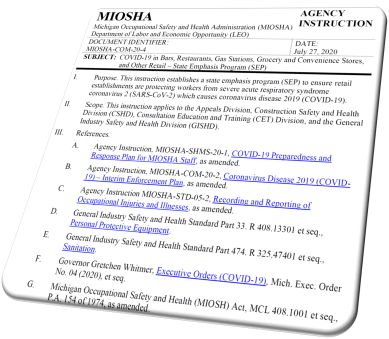
Over the course of the last month, several of our retail clients have been visited by Michigan OSHA (MIOSHA) for COVID-19 enforcement inspections in circumstances without an employee complaint or any self-reported work-related COVID-19 hospitalization or death.  The reason for these inspections, it turns out, is MIOSHA has launched a State Emphasis Program (SEP) on COVID-19 in Bars, Restaurants, Gas Stations, Grocery and Convenience Stores, and Other Retail.  We got our hands on the Directive for the Emphasis Program. Here’s a summary of what Michigan employers in those industries need to know about MIOSHA’s new enforcement strategy.

The Directive lays out MIOSHA’s approach for selecting various retail and hospitality workplaces for programmed inspections about COVID-19 infection control.

The stated purposes of the Emphasis Program is to “increase MIOSHA’s presence in retail establishments to ensure workers are protected from SARS-CoV-2,” because “employees who come in contact with large numbers of people as a result of their employment [like in retail] are at elevated risk of infection.”

The inspections are evaluating the employer’s adherence to Governor Whitmer’s Executive Orders for COVID-19, OSHA Guidance on Preparing Workplaces for COVID-19, and applicable CDC guidance for COVID-19.

The agency has created a targeting list of retail/hospitality businesses broken down as follows:

Continue reading

OSHA’s New Site-Specific Targeting Enforcement Program [Webinar Recording]

On March 19, 2019 Amanda Walker, Aaron Gelb and Dan Deacon of Conn Maciel Carey LLP‘s national OSHA Practice presented a webinar regarding: “OSHA’s New Site-Specific Targeting Enforcement Program.

More than two years after OSHA published the E-Recordkeeping Rule, the agency finally revealed some of its plans for how it will utilize employers’ 300A injury data collected under the new Rule.  In late October 2018, OSHA launched its new Site-Specific Targeting Enforcement Program, which outlines how the agency will select non-construction establishments for programmed inspection. OSHA will create targeted inspection lists based on employers’ higher than average Days Way, Restricted or Transfer (“DART”) injury rates. OSHA will also include a random sample of establishments with lower than expected injury rates for quality control. Thus, all employers covered by OSHA’s E-Recordkeeping Rule may be subject to an SST inspection.

Participants in this webinar learned: Continue reading

OSHA’s New Emphasis Program for Fertilizer Grade Ammonium Nitrate and Anhydrous Ammonia

By: Aaron R. Gelb and Beeta B. Lashkari

On September 25, 2018, OSHA announced the launch of a new Regional Emphasis Program (REP) to address the hazards from exposure to fertilizer grade ammonium nitrate (FGAN) and agricultural anhydrous ammonia.  The REP, effective October 1, 2018, covers the states of Arkansas, Louisiana, Oklahoma, and Texas in OSHA Region VI, and Kansas, Missouri, and Nebraska in OSHA Region VII.  OSHA will commence enforcement activities on January 1, 2019, after a three-month period of education and prevention outreach.  FGAN REP_2Generally, enforcement activities will include the inspection and review of: (1) production operations and working conditions; (2) injury and illness records; (3) safety and health programs; and (4) chemical handling and use.  OSHA’s decision to initiate a new REP covering two regions and seven states is yet another reminder that the agency is continuing full-speed ahead with enforcement efforts.  While many anticipated that the Trump administration would retire OSHA’s national, regional and local emphasis programs, that has not happened.  To the contrary, OSHA continues to implement the same number of enforcement emphasis programs as at the end of the Obama administration.

What prompted OSHA to act now?

On April 17, 2013, a fire and explosion involving FGAN occurred at the West Fertilizer Company in West, Texas, resulting in at least 14 fatalities.  While OSHA and the West Fertilizer Company ultimately reached a settlement, OSHA initially issued more than 20 citations, including several under Section (i) of its Explosives and Blasting Agents Standard.  Continue reading