Navigating OSHA and MSHA Operations During the Federal Shutdown

By Eric J. Conn, Nicholas W. Scala, and Hema Steele

With the federal government now shut down, the Department of Labor (DOL) has invoked its shutdown contingency plan that will remain in effect until Congress appropriates funding.  Shutdowns occur because the Antideficiency Act prohibits federal agencies from operating without appropriations unless they are addressing emergencies involving human life or property.

The following summarizes key implications for employers facing OSHA and MSHA matters.

OSHA

Operations

OSHA will furlough 1,204 of its 1,664 employees, retaining only those essential for emergency and statutory enforcement and to assist orderly shutdown activities. The agency will continue the following enforcement activities: Continue reading

A (Brief) Preview of the Future of Workplace Safety & Health: Trump’s Nominee to Lead OSHA Appears Before the Senate HELP Committee

By Aaron Gelb, Eric J. Conn, Kate McMahon, and Rachel Conn

On Thursday, June 5, David Keeling, President Trump’s nominee to serve as Assistant Secretary of Labor (OSHA), appeared before the Senate Committee on Health, Education, Labor and Pensions (the “HELP Committee”).  After starting his career as a package handler, and member of the Teamsters union, at United Parcel Service (UPS) in 1985, held a variety of safety-focused roles, eventually serving as the global head of safety for the package handling giant.  After his long and distinguished career in safety at UPS, Keeling served as the Director of Road and Transportation Safety at Amazon from 2021 to 2023, during which time the company was working to resolve OSHA investigations through improved ergonomic safety procedures.

Regular readers of the OSHA Defense Report no doubt recall that during the first Trump Administration (2017-2021), for the first time in OSHA’s history, the agency went four years without a Senate-confirmed Assistant Secretary at the helm.  The second Trump Administration appears to be taking a very different approach by quickly nominating Keeling and ensuring that he gets his turn before the Senate HELP Committee before the Summer begins, increasing the odds that there will be a Trump-appointed Head of OSHA before the Fall of the first year of President’s Trump second term.

Keeling prefaced his remarks by stating Continue reading

[Webinar] The Usual Suspects: How to Avoid the Five Most Expensive (and Frequently Cited) Types of General Industry Citations

On Thursday, March 20th, 2025 at 1 p.m. ET / 10 a.m. PT, join Aaron Gelb, Daniel Deacon, and Hema Steele for a webinar on The Usual Suspects: How to Avoid the Five Most Expensive (and Frequently Cited) Types of General Industry Citations.

Year in and year out, the same 5 standards tend to be cited the most frequently in general industry inspections. While their placement in the Top 5 may vary from time to time, Lockout/TagoutHazard CommunicationRespiratory ProtectionPowered Industry Trucks, and Machine Guarding are consistently cited more often than any other standards during inspections of general industry employers. In terms of the financial impact, the order changes slightly with LOTO and machine guarding leading the way, followed by PITs, respiratory protection, and Haz Com.

No matter how you slice the numbers, the fact that these standards consistently occupy the top spots in these annual lists means that employers should prioritize compliance with the many requirements found in each standard; doing so will result in safer and healthier workplaces, not to mention more favorable outcomes if and when OSHA shows up.
Continue reading

Senior Leadership at DOL, OSHA, and MSHA Under a 2nd Trump Administration Is Taking Shape

By Eric J. Conn and Darius Rohani-Shukla

As Rep. Lori Chavez-DeRemer braces for a flurry of questions at her confirmation hearing before the Senate Committee on Health, Education, Labor, and Pensions (HELP) on her way to a full Senate vote to become President Trump’s Secretary of Labor, the Trump Administration is assembling its new senior leadership team to oversee workplace safety and labor policy. These key nominees will shape enforcement priorities, compliance strategies, and industry engagement across OSHA, MSHA, and the broader Department of Labor:

  • Lori Chavez-DeRemer – Nominee for Secretary of Labor: A former mayor and member of Congress, with unexpected ties to labor, is expected to emphasize regulatory flexibility and employer engagement.
  • Keith Sonderling – Nominee for Deputy Secretary of Labor: A former EEOC Commissioner and Dept of Labor official with expertise in AI, employment law, and compliance initiatives.
  • David Keeling – Nominee for Assistant Secretary of Labor for OSHA: A veteran of UPS and Amazon with decades of experience managing workplace safety in complex work environments.
  • Amanda Wood Laihow – Nominee for Deputy Assistant Secretary for OSHA: A former Commissioner at the OSH Review Commission and legal and policy expert with the National Association of Manufacturers.
  • Wayne Palmer – Nominee for MSHA Administrator: A regulatory veteran with previous leadership experience at MSHA and in the mining industry.

With these appointments, the second Trump Administration is signaling a shift in labor and workplace safety policy, though how far and how fast the pendulum will swing remains to be seen. Will workplace safety regulations lean toward deregulation, targeted enforcement, or greater collaboration with industry stakeholders? These questions will be central in upcoming confirmation hearings. Below is a deeper look at each nominee and the potential impact of their leadership on the operations of OSHA, MSHA, and the Department of Labor’s many other divisions. Continue reading

The Pendulum Swings: Early Executive Actions by Trump Portend a Major Contraction at OSHA

By Eric J. Conn and Darius Rohani-Shukla

President Trump was sworn in for a second term the morning of January 20th, and he spent the rest of that day setting a record for the most ever Day 1 executive actions (i.e., Executive Orders, Proclamations, pardons, etc.).  Among those Day 1 executive actions (and a couple others that followed later in his first week back in the White House), was a series of Executive Orders (EOs) and directives targeting staffing, budgeting, and rulemaking, which are designed to drastically shrink regulatory and enforcement agencies, like OSHA.  These executive actions – including a hiring freeze, budget cuts, return-to-office mandates, buyouts, and reclassification of career positions into political appointments – are part of a systematic strategy to diminish regulatory agencies.

This effort to shrink OSHA and other executive agencies should come as no surprise to anyone.  Dismantling the administrative state was a stated goal of the first Trump Administration and again from the campaign trail this time, and that was one campaign promise President Trump delivered on the last go around.  By the end of the first Trump Administration, federal OSHA had shrunk to the fewest number of compliance officers in the agency’s history (dropping from 952 compliance officers at the start of the Trump Administration in 2016 to 761 by January 2020), and the agency had a record number of vacancies in “middle management” positions throughout the Area and Regional field offices.

The Biden Administration focused on rebuilding the ranks at OSHA.  Biden had a Deputy Assistant Secretary for OSHA sworn in just a couple of hours after himself on Day 1, and then dedicated the next four years to hiring more than a hundred new compliance officers and filling vacancies through the agency.  By the end of 2023, the Biden Administration had built the number of OSHA inspectors back up to 878.

Starting on Day 1 of the second Trump Administration, the writing has been on the wall for OSHA that it is about to experience another major contraction.  A smaller OSHA means less resources to conduct inspections (OSHA conducted thousands of fewer inspections during the first Trump Administration than during the Obama or Biden Administrations), engage in robust enforcement (the total number of citations and significant enforcement actions decreased during the first Trump Administration), and to work on or promulgate new standards (there was essentially no new rulemaking, other than deregulatory rulemaking, during the first Trump Administration).  We predict similar effects on the work of OSHA during this term.

Here is a breakdown of the key Day 1 and Week 1 executive actions that are designed to weaken federal agencies like OSHA: Continue reading

Trump Nominates Lori Chavez-DeRemer as Labor Secretary

By Samuel Rose

Last week, President-elect Donald Trump announced that he will nominate Rep. Lori Chavez-DeRemer to be the next Secretary of Labor. Rep. Chavez-DeRemer most recently represented Oregon’s 5th District in the US House of Representatives but lost a tight race in her reelection bid.

Chavez-DeRemer is widely considered to be the most pro-union Republican in Congress, and Labor leaders like Teamsters President Sean O’Brien supported her nomination.

Who is Lori Chavez-DeRemer?

Chavez-DeRemer was born in Santa Clara, CA and earned her bachelor’s degree in business administration from California State University, Fresno. She is also a small business owner, having started an anesthesia management company with her husband, an anesthesiologist, in Oregon.

In 2004, she was elected to the city council of Happy Valley, OR, a suburb of Portland, and she was elected mayor in 2010, serving in that position until 2018.  Chavez-DeRemer was elected in 2022 to represent Oregon’s 5th District, but lost her reelection bid this year.

What Bills Did Chavez-DeRemer Support in Congress?

Chavez-DeRemer’s record in Congress supports her reputation for being a pro-union Republican. She was one of only three Republicans to co-sponsor the Protecting the Right to Organize (PRO) Act which would, in part: Continue reading

Trump 2.0, OSHA: Expect Shifts in Federal Enforcement and Rulemaking Priorities As Well As More Aggressive State Plan Enforcement

By Scott Hecker, Rachel L. Conn, Eric J. Conn, and Aaron R. Gelb

As the dust settles on the 2024 Election Cycle and the pundits continue analyzing and dissecting the results, the OSHA/MSHA Team at Conn Maciel Carey draws from decades of experience representing employers during Republican and Democratic administrations to forecast how the workplace safety and health landscape may change with respect to enforcement, compliance assistance, and rulemaking under a second Trump Administration.

Enforcement Resources and Priorities

At the federal level, history can provide insight into the likely priorities of a second Trump term.  As loyal readers of this blog know, OSHA operated without a confirmed Assistant Secretary for the entirety of the first Trump Administration.  While agencies lacking Senate-confirmed leaders can feel adrift and directionless, with confusion about roles, responsibilities, and priorities, it was essentially business as usual at OSHA under Trump—at least until COVID-19 hit—with other agencies facing more focused efforts to deregulate.  While it is not yet clear how quickly the second Trump Administration will turn its sights to OSHA, we’re unlikely to see a push to increase OSHA’s budget or even to backfill enforcement personnel who leave the agency.  OSHA had the fewest compliance officers in its history during the Trump Administration, and despite efforts by President Biden to increase staffing levels, the number of enforcement personnel is sure to ebb again.  Fewer compliance officers will lead to decreased enforcement activity, as well as overwhelming workloads for remaining employees, and such a combination often results in reduced morale.

OSHA under Trump 2.0 is likely to adopt more employer-friendly policies than President Biden’s current administration and could: Continue reading

OSHA Updates Animal Slaughtering and Processing Worker Safety Enforcement Inspection Guidance

By Eric J. Conn and Samuel S. Rose

On October 15, 2024, OSHA issued Inspection Guidance for Animal Slaughtering and Processing Establishments that updates enforcement protocols for the agency’s field staff and compliance guidance for employers in NAICS Code 3116 (Animal Slaughtering and Processing), which includes NAICS Codes 311611 (Animal (except Poultry) Slaughtering), 311612 (Meat processed from carcasses), 311613 (Rendering and meat byproduct processing), and 311615 (Poultry processing).   The guidance takes the form of a memorandum from the Director of OSHA’s Directorate of Enforcement Programs out to all of OSHA’s Regional Offices.

OSHA justified the need for the updated enforcement guidance by noting that animal slaughtering and processing workers suffer serious injuries at a rate that is more than double that of all industries combined.

The updated OSHA guidance supersedes and replaces OSHA’s October 28, 2015 “Inspection Guidance for Poultry Slaughtering and Poultry Processing Establishments.

The memorandum encourages each OSHA Region to determine whether a special enforcement emphasis program — either a Regional or Local Emphasis Program — is justified after reviewing relevant data in their regions. There are currently active emphasis programs in Region 4 (Regional Emphasis Program for Poultry Processing Facilities covering Georgia, Florida, North Carolina and South Carolina), Region 5 (Regional Emphasis Program for Food Manufacturing Industry covering Illinois, Ohio, Wisconsin, Michigan, Indiana, and Minnesota), Region 6 (Regional Emphasis Program for Poultry Processing Facilities covering Texas, Oklahoma, Arkansas, Louisiana, and New Mexico), and Region 7 (Nebraska Local Emphasis Program for Meat Processing Industries).  Because OSHA believes these hazards are pervasive nationwide, State OSH Plans, especially those with significant meat and poultry processing industries, are encouraged by OSHA in this enforcement memorandum to follow this guidance document.

Pursuant to OSHA’s updated memorandum, all programmed and unprogrammed inspections in NAICS 3116 will scrutinize Continue reading

Destabilized But Not Yet Deconstructed: Analysis of This Momentous SCOTUS Term for the Administrative State

By Conn Maciel Carey’s national OSHA Practice Group

The 2023-2024 Term of the United States Supreme Court will undoubtedly have far-reaching implications in a number of areas, but perhaps most significantly—at least for regular readers of the OSHA Defense Report blog—with respect to the ability of federal agencies to promulgate and enforce regulations.  In a trio of recent decisions addressing federally mandated monitors in fishing vessels (Loper Bright v. Raimondo), civil fines imposed by the Securities and Exchange Commission (SEC v. Jarkesy) and payment network processing fees incurred by a truck stop (Corner Post, Inc. v. Board of Governors of the Federal Reserve System), the High Court sent shockwaves that will likely reverberate through all federal agencies and the regulated community alike for years to come.

The familiar framework in which these agencies have long operated, dating back to the mid-1980s when Chevron, U.S.A., Inc. v. Natural Resources Defense Council, Inc. was decided, appears to have been upended, or at least is now resting on shaky ground. And while these three decisions do not, by themselves, dismantle the administrative state, they have the potential to significantly reorder the familiar foundations upon which OSHA and dozens of other administrative agencies have operated.

Perhaps most importantly, these decisions appear to open the door wide for future challenges to vast swaths of the Code of Federal Regulations that currently govern how businesses and other regulated entities operate today and the venue where regulatory disputes are resolved. This article examines the implications of these cases and offers some educated speculation about the sea change that may occur at OSHA and elsewhere over the next few years. Continue reading

Industry Groups and Congressional Leaders Attack OSHA’s New “Worker Walkaround” Inspection Rule

By Eric J. Conn, Mark Trapp, and Darius Rohani-Shukla

To advance the Biden Administration’s promise to be “the most labor friendly administration in history,” on April 1, 2024, OSHA published in the Federal Register its Final Worker Walkaround Representative Designation Process Rule (the “Worker Walkaround Rule”). The new Final Rule amends OSHA’s regulation at 29 CFR 1903.8(c) – Representatives of Employees and Employers – to open the door to participation in OSHA inspections by third parties, including union representatives at non-union workplaces, disgruntled former employees, plaintiffs’ attorneys or their experts, and scores of others.

OSHA’s new final rule went into effect on May 31, 2024, but ten days before that, on May 21st, the US Chamber of Commerce, with various other industry and business groups, filed a lawsuit in the US District Court for the Western District of Texas challenging the legality of OSHA’s new Worker Walkaround Rule.  The lawsuit, Chamber of Commerce v. OSHA, seeks to postpone enforcement of OSHA’s new Worker Walkaround Rule and ultimately to permanently vacate the new regulation. Continue reading

Everything You Need to Know About OSHA’s New Worker Walkaround Representative Designation Process Rule

By Eric Conn, Mark Trapp, and Darius Rohani-Shukla

Like a bad April Fool’s joke, to advance the Biden Administration’s promise to be “the most labor friendly administration in history,” on April 1, 2024, OSHA published in the Federal Register its Final Worker Walkaround Representative Designation Process Rule (the “Worker Walkaround Rule”). The new Final Rule amends OSHA’s regulation at 29 CFR 1903.8(c) – Representatives of Employees and Employers – and will profoundly affect employers’ legal risk in future OSHA inspections when it goes into effect on May 31, 2024.

This Client Alert covers the controversial history of this rulemaking, from an Obama Era Letter of Interpretation and related legal challenges, through the flawed rulemaking process that OSHA followed to promulgate the new rule, to a detailed review of what the final rule says and means, along with analysis about the implications for employers, expected legal challenges to the Rule, and tips and strategies for managing OSHA inspections in this new world order.

Background

OSHA’s regulation governing participation in OSHA inspection by employee representatives, 29 C.F.R. 1903.8(c), was established in 1993, and it granted employees and their representatives the right to accompany OSHA compliance officers during the physical walkaround phase of workplace inspections.  In February 2013, the Obama-Biden Administration sought to give union representatives authority to participate in OSHA inspections at non-union workplaces by way of a formal Letter of Interpretation.  The interpretation letter responded to an inquiry by a labor union about inspection rights:

May workers at a worksite without a collective bargaining agreement designate a person affiliated with a union or a community organization to act on their behalf as a walkaround representative?

That question had to be considered within the context of the existing regulatory text of 29 C.F.R. 1903.8(c) at that time:

The representative(s) authorized by employees shall be an employee(s) of the employer. However, if in the judgment of the Compliance Safety and Health Officer, good cause has been shown why accompaniment by a third party who is not an employee of the employer (such as an industrial hygienist or a safety engineer) is reasonably necessary to the conduct of an effective and thorough physical inspection of the workplace, such third party may accompany the Compliance Safety and Health Officer during the inspection.

Notwithstanding pretty clear regulatorylimitations to third party inspection participation rights, including an expectation that any third party participant must have some type of technical credential (e.g., professional safety engineer or certified industrial hygiene), OSHA responded to the union’s interpretation request in the affirmative, explaining: Continue reading

BREAKING: OSHA Issues Final Worker Walkaround Representative Designation Process Rule

By Eric Conn, Mark Trapp, and Darius Rohani-Shukla

After an unusually short time at OMB, earlier today, OSHA revealed a pre-publication version of its Final Worker Walkaround Representative Designation Process Rule.  The Official Final Rule will issue when it is published in the Federal Register next week, on April 1, 2024, and it will go into effect on May 31, 2024.

As expected, OSHA pushed this rule out ahead of the Congressional Review Act window – 60 legislative days before a possible transition to a new Administration and new Congress. By issuing the rule this far ahead of the next election, OSHA has avoided the risk that a possible new Republican Congress and President could repeal this rule under the CRA, preventing OSHA from ever promulgating a substantially similar rule in the future.

As a reminder, OSHA initially sought to amend its existing regulation at 29 CFR § 1903.8(c) in three ways:

  1. Changing the extreme bias against third party employee representative participation in OSHA inspections by changing existing language to allow non-employee third parties to act as employee representatives during OSHA inspections;
  2. Expanding the types of third parties permitted to represent employees during OSHA inspections by changing existing language limiting such representatives to credentialed certified industrial hygienists or professional safety engineers, to now permitting any third-party representative who has “relevant knowledge, skills, or experience with hazards or conditions in the workplace or similar workplaces, or language skills”; and
  3. Expanding the role these third-party representatives play during an OSHA inspection from simply “accompanying” OSHA during the physical walkaround phase of the inspection, to “participating” in the inspection, which presumably would include attending and asking questions during private employee interviews, reviewing the employer’s records produced to OSHA pursuant to OSHA’s broad subpoena authority, etc.

Conn Maciel Carey’s OSHA Rulemaking Coalition pushed back on all of these changes, and it appears we achieved a little success.  Here is the new final regulatory text: Continue reading

OSHA’s Worker Walkaround Rule Clears OMB Review – Final Rule Is Imminent

By Eric Conn, Mark Trapp, and Darius Rohani-Shukla

We have an important update to share about the status and now more clear outcome of OSHA’s rulemaking for a Worker Walkaround Designation Process Rule.  Yesterday, OMB updated the entry on its website about the Worker Walkaround Rulemaking to reflect that OMB/OIRA has concluded its regulatory review under EO 12866, cancelling the remaining stakeholder meetings that had been scheduled.  In total, OMB hosted sixteen EO 12866 stakeholder meetings.  The entry reflecting the EO 12866 meeting with Conn Maciel Carey’s Rulemaking Coalition’s is here.

As you can see below, OMB has updated its entry for this rulemaking to reflect: “OIRA Conclusion of EO 12866 Review.”

What we can also see from this entry is that OMB has, unfortunately, NOT Continue reading

OSHA Sends Proposed Final “Worker Walkaround Representative Designation Process” Rule to OMB

By Eric Conn, Mark Trapp, and Darius Rohani-Shukla

In early 2023, OSHA revealed plans for a rulemaking for a Worker Walkaround Representative Designation Process Rule that would amend existing regulation 29 CFR § 1903.8(c), which governs participation by third parties in OSHA inspections as employee representatives. The proposed rule changes three key components of that regulation:

  1. Changing the existing language that historically has generally limited employee representation during an OSHA inspection to individuals who are employees of the employer that is being inspected, to now allow non-employee third parties to act as employee representatives during OSHA inspections.
  2. Expanding the types of third parties permitted to represent employees during OSHA inspections. The existing regulation focuses on non-employees with a technical credential, “such as an industrial hygienist or a safety engineer” to accompany OSHA on an inspection when it “is reasonably necessary to the conduct of an effective and thorough physical inspection of the workplace[.]” The new Proposal eliminates the limitation to these technical experts, and indicates that a third party representative may be “reasonably necessary” because of “relevant knowledge, skills, or experience with hazards or conditions in the workplace or similar workplaces, or language skills.”
  3. The proposed rule may also expand the role these third party representatives play during an OSHA inspection. The OSH Act and the existing regulation speak in terms of the representative “accompanying” OSHA during the walkaround phase of the inspection, but the proposed amended rule introduces the term “participate,” which could mean OSHA intends for these third parties to have a more active role; e.g., attending and asking questions during private employee interviews, reviewing the employer’s records produced to OSHA pursuant to OSHA’s broad subpoena authority, etc.

Continue reading

Solicitor of Labor Publishes Annual “Enforcement Report” for 2023

By Darius Rohani-Shukla and Eric J. Conn

In late January 2024, the Department of Labor released its annual report summarizing the Solicitor of Labor’s (SOL) enforcement work in FY 2023. SOL enforces more than 180 federal statutes and their implementing regulations. This report is a helpful resource for employers as it demonstrates SOL’s most recent enforcement priorities. In its report, SOL emphasized three aspects of its FY23 enforcement work:

  • SOL’s Emphasis on Retaliation Claims;
  • SOL’s Use of Litigation and Amicus Work to Affect Employee Misclassification and Coercive Employer Tactics; and
  • SOL’s Willingness to Use All Tools at its Disposable.

As the Solicitor of Labor said as an introduction to the report:

“We recognize that as the government, we play a unique role in the federal labor enforcement landscape…. This report will focus on three key aspects of our work: building out our retaliation priority across program areas; utilizing our litigation tools and our amicus and appellate practices to build positive developments in the law, such as combatting misclassification and coercive employer tactics; and deepening our use of all the tools in our toolbox, from warrants, to enhanced
compliance agreements, to criminal enforcement coordination.”

  1. SOL’s Emphasis on Retaliation Claims

Continue reading

OSHA’s 2023 in Review and 2024 Forecast [Webinar Recording]

On Wednesday, January 17, 2024, the Partners in Conn Maciel Carey’s national OSHA Workplace Safety Practice Group presented a webinar covering OSHA’s 2023 in Review and 2024 Forecast.

As we approach a Presidential Election that will determine the shape of OSHA enforcement and rulemaking for years to come, it is time to look back and take stock of what we learned from and about OSHA during another very eventful year. More importantly, it is once again time to look ahead and discuss what employers should expect from OSHA during Year 4 of the Biden/Harris Administration.

In this webinar, we reviewed OSHA enforcement data and trends, important policy changes at OSHA (e.g., expanding the Severe Violator Enforcement Program and per instance citation authority), and major rulemaking developments (e.g., finalizing E-Recordkeeping, and advancing Heat Illness and the Worker Walkaround Representative rulemaking). We also discussed the top OSHA issues employers should monitor and prepare for in the New Year.

Participants in this webinar will learn about: Continue reading

The CSB Clears Its Investigations Backlog With a Flurry of Holiday Season Investigation Reports

By: Beeta B. Lashkari, Eric J. Conn, and Valerie Butera

As we begin the new year, we wanted to look back and report out on a rather remarkable year at the US Chemical Safety and Hazard Investigation Board (the “CSB”).  Most notably, the CSB set and met a goal of clearing out its investigations backlog before the end of CY 2023.  By any measure, the CSB just closed its most productive year ever, issuing a record-setting eleven investigation reports.  For context, the CSB issued only six reports in 2022, three in 2021, none in 2020, and four in 2019.  Currently, the CSB has only two open investigations for incidents that just occurred within the last year and a half.

As we discussed in our December 13, 2022 Process Safety Update Webinar, on May 20, 2021, the Congressional Committee on Energy and Commerce sent the CSB a letter, calling on the CSB to clear out its “investigations backlog,” which, at that time, included 20 open investigations, including at least one that was more than five years old.  The letter specifically instructed the CSB to:

“Provide a copy of the CSB’s most recent investigation plan, including the status of all open investigations, the expected timeframe for completing each investigation, and the number of investigators assigned to each investigation.”

A day later, the CSB released one investigation report, so that, by the time the agency replied to Congress’ letter on June 10, 2021, it reported that there were 19 open investigations, and provided a status for each one: five were noted as being in the early investigation report-writing phase, and 14 were in a mid- or advanced phase.  However, the CSB did not at that time provide a specific timeframe for completing each report, stating only that:

“[t]he timeframe for completing investigations is a dynamic re-assessment based on numerous factors. The Agency plans to continue closing investigations with increased transparency through the public board meeting process . . . and to improving the timelines as the Agency rebuilds our staff and processes.”

Three months later, on September 24, 2021, the CSB issued a couple more investigation reports, and a few days after that, on September 29, 2021, then-CSB Chairperson Katherine Lemos testified before the Subcommittee on Oversight and Investigations of the Committee on Energy and Commerce, emphasizing the progress the CSB was making on the release of investigation reports.  Specifically, Chairperson Lemos testified that the CSB had completed three investigations in 2021, compared to only one in 2020.

Then, on October 7, 2021, the CSB sent another letter to Congress, this time providing a specific timeline for all remaining open investigations.  Per the (very ambitious) timeline, with older investigations prioritized, all open CSB investigations of incidents occurring prior to calendar year 2020 would be completed in fiscal year 2022. Although the CSB was not able to meet its initial timeline, it updated its investigations closure plan in October 2022, committing to another very ambitious timeline to complete all of its then-remaining fourteen open investigations by the end of calendar year 2023.  With a new and nearly full slate of Board Members and renewed life at the agency under the Biden Administration, including the hiring of additional staff, the CSB met that timeline, barely. Continue reading

Announcing Conn Maciel Carey’s 2024 OSHA Webinar Series

Now three full years into the Biden Administration, it is the perfect time to take a close look at what we learned from and about OSHA during these very eventful years.  More importantly, as OSHA has turned the page from the pandemic and started to “use all of the tools available” in its regulatory and enforcement toolbox, it is a good time to look ahead and assess what OSHA’s priorities will be leading up to the Presidential Election this Fall and in the years ahead.  That picture is becoming clearer (and more fraught for employers), as OSHA has drastically increased its penalty authority, reimagined its dreaded Severe Violator Enforcement Program, expanded its “instance-by-instance” citation policy, launched new emphasis programs, worked an aggressive rulemaking agenda, and set new records for significant enforcement actions year after year.  Accordingly, it is more important now than ever before for employers to keep abreast of developments at OSHA.

Conn Maciel Carey’s complimentary 2024 OSHA Webinar Series, which includes monthly programs (sometimes more often) put on by the OSHA-focused attorneys in the firm’s national OSHA Practice Group, is designed to give employers insight into developments at OSHA during this period of unpredictability and significant change.  ​To register for an individual webinar in the series, click on the registration link within the individual program descriptions below, or to register for the full webinar series, click here to send us an email request and we will get you registered for all of the programs.  Also check out our companion Cal/OSHA Webinar Series, MSHA Webinar Series, and Labor & Employment Webinar Series.

If you missed any of our 100+ webinar programs over the past decade, here is a link to recordings in our webinar archive.  If your organization or association would benefit from an exclusive program presented by our OSHA team on any important OSHA-related topic, please do not hesitate to contact us.

OSHA's 2023 in Review and 2024 Forecast

Wednesday, January 17th
Process Safety Management & CalARP

Monday, August 5th
OSHA Recordkeeping & Reporting Update

Thursday, February 8th
Unique Aspects of OSHA-Approved State Plans

Thursday, September 19th
OSH & Employment Law Compliance in ESG

Thursday, March 21st
Employee Retaliation & Whistleblower Claims

Wednesday, September 25th
Tips for Responding to Workplace Violence

Wednesday, April 24th
Cal/OSHA & Employment Law In-Person Summit

Tuesday, Oct. 8th and Thursday, Oct. 10th
Mid-Year Review: OSHA/MSHA Developments

Tuesday, May 28th
Deep Dive: OSHA’s Hazard Communication Rule

Tuesday, October 15th
Impact of EPA's New TSCA Rules on OSHA Chemical Safety Enforcement  

Wednesday, June 12th
Intersection of Artificial Intelligence and OSHA and Employment Law

Wednesday, November 13th
OSHA's Enforcement National & Local Emphasis Programs

Thursday, July 18th
2025 OSHA New Year's Resolutions: 12 Ways to Improve Your OSHA-Readiness

Wednesday, December 18th


See below for the full program descriptions.


Continue reading

Update About OSHA’s Worker Walkaround Designation Process Rulemaking

By Eric Conn, Mark Trapp, and Darius Rohani-Shukla

Back in Q1 of 2023, OSHA revealed plans for a rulemaking for a Worker Walkaround Representative Designation Process Rule, and we have been tracking the rulemaking on the OSHA Defense Report blog since that time.  Specifically, the Worker Walkaround Representative Designation Process rulemaking proposes to amend the existing regulation at 29 CFR § 1903.8(c), which governs participation by third parties in OSHA inspections as employee representatives. The proposed rule changes three key components of the existing regulation:

  1. Changing the existing language that historically has generally limited employee representation during an OSHA inspection to individuals who are employees of the employer being inspected, to now allow non-employee third parties to act as representatives; and
  2. Expanding the types of third parties permitted to represent employees during OSHA inspections. The existing regulation allows a non-employee “such as an industrial hygienist or a safety engineer” to accompany an OSHA compliance officer during an inspection when it “is reasonably necessary to the conduct of an effective and thorough physical inspection of the workplace[.]” The specific reference in the regulation to these technical credential has meant that only representatives with relevant technical expertise, credentials, or unique language skills have been permitted to accompany OSHA.  The new Proposal eliminates the limitation to these technical experts, and indicates that a third party representative may be “reasonably necessary” because of “relevant knowledge, skills, or experience with hazards or conditions in the workplace or similar workplaces, or language skills.”
  3. The proposed rule may also expand the role these third party representatives can play during the inspection. The OSH Act and the existing regulation speak in terms of the employee representative “accompanying” OSHA during the walkaround phase of the inspection, but the proposed amended rule introduces the term “participate,” which could mean OSHA intends for these third parties to have a more active role; e.g., attending and asking questions during private employee interviews, reviewing the employer’s records produced to OSHA, etc.

Conn Maciel Carey’s national OSHA and Labor & Employment Practice Groups formed the Employers Walkaround Representative Rulemaking Coalition, composed of a broad and diverse group of employers and trade associations representing many industries, including retail, manufacturing, petroleum refining, construction, food manufacturing and distribution, agricultural, and more, with millions of employees across thousands of workplaces in every state in the US. On behalf of that rulemaking coalition, we recently submitted a comprehensive set of written comments to OSHA’s rulemaking docket.  In this post, we provide you with a summary of our comments that detailed:

  1. The concerning ways the proposed rule would impact employers;
  2. How the proposed rule conflicts with the OSH Act, the National Labor Relations Act, and the US Constitution; and
  3. How the rulemaking process has violated the Administrative Procedure Act and Executive Order 12866

The written comments submitted on behalf of the Employers Walkaround Representative Rulemaking Coalition, available here (https://www.regulations.gov/comment/OSHA-2023-0008-1976), present our concerns that the Proposal would open a flood gate to a multitude of workplace disruptions.  Specifically, we explained how: Continue reading

New Memorandum of Understanding Between OSHA and the NLRB Will Drive Coordinated Enforcement Efforts

By Kimberly Richardson and Eric J. Conn

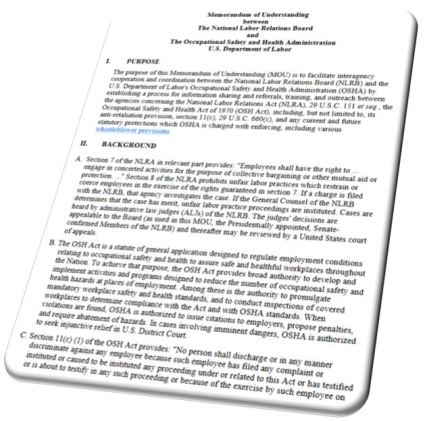
On October 31, 2023, the Occupational Safety and Health Administration (OSHA) and the National Labor Relations Board (NLRB) signed a new Memorandum of Understanding (MOU) to coordinate investigations and other enforcement activities. The agencies’ coordinated enforcement applies not only to protections afforded to employees under the Occupational Safety and Health Act (OSH Act) and the National Labor Relations Act (NLRA), but it also applies to the 20 plus whistleblower laws that OSHA is charged with enforcing. The OSH Act and the NLRA both include protections for workers who complain to management about unsafe or unhealthy working conditions.

The purpose of the MOU is to:

“facilitate interagency
cooperation and coordination between the [NLRB] and [OSHA] by
establishing a process for information sharing and referrals, training, and outreach between
the agencies concerning the [NLRA], 29 U.S.C. 151 et seq., the
[OSH Act], including, but not limited to, its
anti-retaliation provision, section 11(c), 29 U.S.C. 660(c), and any current and future
statutory protections which OSHA is charged with enforcing, including various
whistleblower provisions.”

Under the new MOU, OSHA and the NLRB agreed to the following:

  • Information Sharing. OSHA and the NLRB and OSHA may, either upon request or upon one of the agency’s own initiative, share information or data that supports enforcement mandates regardless of whether the information or data was obtained through investigations or from other sources.
  • Coordinated Investigations and Inspections. Where OSHA or NLRB suspects there are overlapping statutory violations at issue, they will coordinate investigations and inspections with the other “in appropriate cases and to the extent allowable under law.”
  • Informing Employees About Their Rights. The MOU provides guidance for OSHA and NLRB staff on how to inform complainants and charging parties of their rights under the NLRA and any act enforced by OSHA, and how to contact the appropriate agency for further assistance. Continue reading

OSHRC ALJ Decision in the Americold Logistics Case Highlights Importance of Safety Self-Audits

Documented efforts to proactively audit and/or observe employees to confirm compliance with employer safety programs, policies, and procedures is, in our opinion, one of the most important aspects of a workplace safety and health program.  Not only do such efforts help prevent accidents and reinforce good behavior, but having documented records reflecting regular observations of safe work practices may enable an employer to negate OSHA’s prima facie case by preventing the agency from showing the employer had knowledge of the alleged violation.  Documented internal auditing/observations are also often the key to successfully asserting the employee misconduct defense in response to an OSHA citation.  I frequently emphasize this when speaking or writing about challenging standards like lockout/tagout (LOTO), personal protective equipment (PPE), and powered industrial trucks (PIT), as I all too often see employers expecting to get a citation vacated because they have an instance or two of some form of safety related discipline found by happenstance or because an accident occurred, not resulting from proactive, intentional audits.

A recent Occupational Safety and Health Review Commission (OSHRC) decision in which an Administrative Law Judge (ALJ) vacated a PIT citation illustrates the value of proactive audits and observations.  See Americold Logistics, LLC, No. 22-1400 (OSHRC Aug. 22, 2023).  In the case, OSHA, seeking to affirm a citation alleging that the employer allowed an untrained employee to operate a powered industrial vehicle (PIV) in violation of 29 CFR 1910.178(l)(1)(ii), argued that, while the company may not have had actual knowledge of the violation, it nevertheless had constructive knowledge.  Constructive knowledge is shown where OSHA establishes that the employer could have known of the cited condition with the exercise of reasonable diligence.  Whether an employer was reasonably diligent involves a consideration of several factors, including the employer’s obligation to have adequate work rules and training programs, to adequately supervise employees, to anticipate hazards to which employees may be exposed, and to take measures to prevent the occurrence of violations.  Reasonable diligence, the ALJ explained, implies effort, attention, and action; not mere reliance upon the action of another.  As such, OSHRC has held that “[r]easonable steps to monitor compliance with safety requirements are part of an effective safety program.”

In Americold, the ALJ noted that the company, in addition to training and certifying its PIV operators, “took reasonable steps to monitor compliance with safety requirements.”  This included two forms of routine, documented monitoring of employee safety and performance – first, floor supervisors had to conduct three “behavior-based safety observations” per day followed by coaching, both of which were documented; and second, Americold required floor supervisors to conduct “coaching method observations” twice per day.  Americold was also able to demonstrate that, when safety violations were observed, employees were disciplined, including three employees terminated in the six months preceding the accident for rule violations related to PIV operation.  As a result, the ALJ held that OSHA failed to establish that Americold did not exercise reasonable diligence to ensure only trained individuals operate PIVs at its facility.

Employers looking to improve safety and obtain better outcomes when contesting citations would be well-advised to follow Americold’s example.  If you want to talk through what this would look like at your company, give one of the OSHA-focused attorneys at Conn Maciel a call.

OSHA Proposes Rule that May Allow Union Organizers and Plaintiffs’ Attorneys to “Walk Around” Workplaces

By Eric J. Conn and Mark Trapp

Earlier this month, OSHA issued a Notice of Proposed Rulemaking for a “Worker Walkaround Representative Designation Process” Rule, which would expand the circumstances when non-employees, particularly union representatives at non-union workplaces, can accompany OSHA inspectors during enforcement inspections.

The proposed rule would allow union representatives, other labor or community activist groups, and even plaintiffs’ attorneys (or their expert witnesses) direct and early access to non-union workplaces and employees, potentially as a front for organizing campaigns where they otherwise would not have access or to advance personally injury lawsuits. Similarly, the rule could allow competitors, contractors, or others onsite to employers’ detriment.

The Washington Legal Foundation featured an article by Eric J. Conn of Conn Maciel Carey’s national OSHA Practice and Mark Trapp of CMC’s Labor & Employment Practice about this development. Here is a link to the WLF article.

Employers OSHA Inspection Walkaround Rulemaking Coalition

With that backdrop, we understand that employers have a strong interest in having a seat at the table for this rulemaking.  To that end, Conn Maciel Carey’s OSHA Practice and Labor Law Practice are collaborating to organize a fee-based company-anonymous coalition of employers and trade groups to advocate for the most reasonable possible fed OSHA regulation about third party participation in OSHA inspections. Continue reading

OSHA Launches Enforcement National Emphasis Program Targeting Warehouses, Distribution Centers and High-Risk Retailers

By Eric J. Conn and Darius Rohani-Shukla of Conn Maciel Carey LLP’s National OSHA Practice

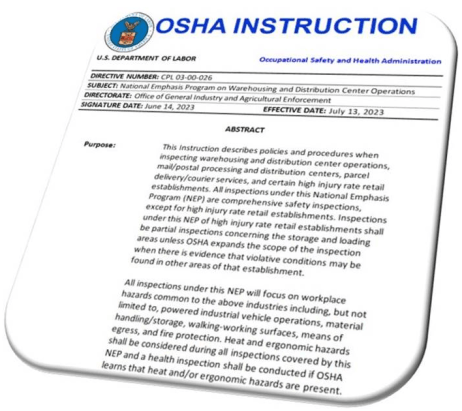
On July 13, 2023, OSHA announced a new enforcement National Emphasis Program focused on Warehousing and Distribution Center Operations.  The new NEP was signed-off by the Head of OSHA a month ago – on June 14, 2023 – so it became effective as of July 13, just as the public was first learning about it.  We have combed through the Directive for OSHA’s new Warehouses NEP and identified the following key information that warehouse operators and retailers need to know.

What motivated OSHA to Launch the Warehouses NEP?

Over the last ten years, warehousing and distribution centers have experienced tremendous growth, with the number of estimated employees in that industry nearly tripling from 2011 to 2021.  As part of that growth, the injury and illness rate in that space has also dramatically increased.  Specifically, OSHA’s perspective is that this NEP is warranted because of Bureau of Labor Statistics (BLS) data that shows that injury and illness rates for the establishments covered by the NEP are significantly higher than the overall industry average.  As a result, OSHA’s new Warehouses NEP is tailored to address the hazards in those workplaces that OSHA deems as posing the most safety and health hazards.

The Assistant Secretary of Labor for OSHA, Doug Parker, had this to say about the new Warehouses NEP:

“Our enforcement efforts are designed to do one thing: lead to permanent change in workplace safety.  This emphasis program allows OSHA to direct resources to establishments where evidence shows employers must be more intentional in addressing the root causes of worker injuries and align their business practices with the goal to ensure worker health and safety.”

What Employers are covered by this NEP?

This NEP targets warehouse-related industries as identified by seven NAICS codes, as well as a set of “high-injury retail establishments,” as identified by five NAICS codes.  Here are the specific warehouse industry segments covered by the NEP:

The so-called “high-injury rate retail establishments” are a subset of the retail industry with particularly high industry average DART rates; i.e., high rates of injuries and illnesses that cause days away from work, restricted duty, or job transfer.  They were included because OSHA believes they present the same or similar hazards as warehousing and distribution facilities, particularly in loading and storage areas.  Here are the specific retail industry segments covered by this NEP: Continue reading

10 Reasons Why It Is Critical For Employers To Get OSHA Injury and Illness Recordkeeping and Reporting Right — And How to Ensure It is Done Right

By Eric J. Conn and Lindsay A. DiSalvo

Although OSHA injury and illness recordkeeping and reporting has always been important from an OSHA compliance perspective, making correct recording and reporting decisions (i.e., not over- or under- recording or reporting) has never been more vital than it is today. We are at a moment in OSHA’s history when the agency is clearly staffing up and ramping up inspections and enforcement generally, and with respect to injury and illness recordkeeping specifically, OSHA is on the precipice of issuing a significant expansion of the injury and illness data required to be submitted to OSHA each year.  Indeed, OSHA sent the final Electronic Recordkeeping Rule to OMB for final review, which is the last step in the rulemaking process before the rule is published.

OSHA developed and repeatedly touted its injury and illness recordkeeping program as a “no fault” system, requiring certain injuries and illnesses to be recorded (or proactively reported to OSHA), regardless whether the employer or its safety program could have prevented the injury. In practice, however, recordkeeping data has become another tool OSHA uses to justify enforcement efforts and actions against specific employers or their industries. From publicizing recordkeeping data to “shame” employers, or using the data to target enforcement resources, OSHA has made it essential for employers not to over-record cases; i.e., they must carefully scrutinize each potential recordable injury or illness, rather than erring on the side of recording every close call. Of course, there are also real and growing enforcement risks for under-recording; i.e., failing to record or report cases that should have been recorded or reported.

Accordingly, it is more important than ever before to make sure your organization fully understands the nuances of OSHA’s recordkeeping and reporting requirements.

Here is our take on the Top 10 reasons it is critical for employers to get OSHA injury and illness recordkeeping and reporting right (not recording or reporting more cases than necessary, and not failing to record or report cases that should be):

1.  OSHA’s Electronic Recordkeeping, which puts previously internal data now in OSHA’s hands and on its public website, is about to expanded significantly.

As a result of OSHA’s E-Recordkeeping rule, employers’ injury and illness data is now published on OSHA’s public website.  Unfortunately, because OSHA’s injury and illness recordkeeping program was designed to Continue reading

Uh Oh, OSHA’s Here: How to Prepare For and Manage OSHA Inspections [Webinar Recording]

On Thursday, June 8, 2023, Aaron Gelb, Mark Ishu, Dan Deacon and Ashley Mitchell presented a webinar regarding Uh Oh, OSHA’s Here: How to Prepare For and Manage OSHA Inspections.

Over the past year, the number of OSHA inspections has soared, especially since the COVID-19 pandemic eased, and the National Emergency has now come to an end. We are seeing, as part of OSHA’s focused effort to use (and sharpen) all the tools in its toolbox, more inspections, higher penalties, record numbers of $100K+ citation packages, and a continuing rise in willful and repeat citations and worker safety criminal prosecutions. OSHA continues, also, to look for new and creative ways to proactively inspect employers with targeted enforcement initiatives and emphasis programs, while also significantly expanding punitive measures such as the Severe Violator Enforcement Program (or SVEP), and the new Instance-by-Instance citation policy), creating a number of minefields for even the most conscientious employers. In short, the consequences for employers being caught ill-prepared for an OSHA inspection, and making bad choices during an inspection, are more dire now than ever.

This webinar provided Continue reading