Michigan Lawmakers Consider Raising MIOSHA Penalties to Match Federal Levels

By Tony Casaletta, Valerie Butera, and Darius Rohani-Shukla

On October 23, 2025, the Michigan Senate Labor Committee heard testimony on Senate Bills 49 and 50 (SB 49–50) — legislation aimed at raising Michigan Occupational Safety and Health Administration’s (MIOSHA) civil penalty authority to match federal OSHA penalty levels. Supporters of the bills, including lawmakers and safety officials, emphasized that updating Michigan’s penalty structure is crucial to keeping the state in compliance with federal requirements and preserving Michigan’s authority to effectively regulate workplace safety. Without these adjustments, Michigan risks losing its approved State OSH Plan status, which allows the state to manage its own occupational safety and health program rather than defaulting to federal OSHA jurisdiction over Michigan workplaces.

Both bills would also shift MIOSHA administration and enforcement responsibilities from the Department of Licensing and Regulatory Affairs (LARA) and Department of Health and Human Services (DHHS) to the Department of Labor and Economic Opportunity (LEO). This centralization is intended to streamline oversight and align MIOSHA with broader labor and employment policy initiatives.

Why the Change Is Needed Continue reading

MIOSHA Aligns with Federal OSHA’s Controversial New Worker Walkaround Rule: What Michigan Employers Need to Know

By Valerie Butera, Anthony Casaletta, and Darius Rohani-Shukla

Michigan employers, take note: as of March 4, 2025, the Michigan Occupational Safety and Health Administration (MIOSHA) has officially amended Administrative Rule Part 13 – Inspections and Investigations, Citations, and Proposed Penalties to align with federal OSHA’s newly finalized Worker Walkaround Representative Designation Process Rule. This change significantly alters how employee representation works during MIOSHA workplace inspections—and carries substantial implications for employers across the state.

What Changed?

The amendment to MIOSHA’s Admin. Part 13 was prompted by federal OSHA’s update to 29 CFR 1903.8(c), which provides that a non-employee third-party may serve as an employee representative during an OSHA inspection and accompany the Compliance Safety and Health Officer (CSHO) during the physical inspection of the workplace. MIOSHA’s rule now mirrors this federal standard, allowing third-party representatives to accompany CSHOs during inspections when deemed “reasonably necessary.”

In plain terms, this means employee walkaround representatives no longer need to be employees of the company being inspected. Union representatives, attorneys, community organizers, and others can now potentially participate in inspections—even at non-union workplaces—if OSHA or MIOSHA determines they bring relevant skills, knowledge of hazards, or even language fluency needed for the inspection.

The Backstory: From Legal Fight to Final Rule Continue reading

Michigan OSHA Enforcement and Regulatory Update [Webinar Recording]

On Wednesday, November 30, 2022, Anthony Casaletta and Eric Conn presented a special bonus webinar in Conn Maciel Carey’s 2022 OSHA Webinar Series regarding a Michigan OSHA Enforcement and Regulatory Update.

Presented by
Anthony M. Casaletta and Eric J. Conn

We are pleased to announce that CMC’s newest addition, Tony Casaletta, a former Michigan OSHA (MIOSHA) Official who has just joined the firm as Of Counsel, led our very first MIOSHA update. Prior to joining the firm, Tony spent 18 years with MIOSHA in various roles, working his way up to Health Supervisor for the MIOSHA Construction Safety and Health Division.  Through his tenure at MIOSHA, Tony specialized in industrial hygiene enforcement in both general industry and construction, managed the MIOSHA Asbestos Program, and oversaw the enforcement activities of MIOSHA’s Construction field industrial hygienists throughout the state of Michigan. In addition, Tony worked as an adjunct professor at Wayne State University where he taught in the University’s Industrial Hygiene graduate program.

Tony was joined by the firm’s OSHA Chair, Eric J. Conn, also a proud member of the Michigan Bar. The two OSHA-specialist attorneys provided an overview of MIOSHA’s enforcement program, the latest data and trends in MIOSHA enforcement, and other MIOSHA issues for employers to monitor.

During this webinar, participants learned about: Continue reading

[Bonus Webinar] Michigan OSHA Enforcement and Regulatory Update

On Wednesday, November 30, 2022, at 1 p.m. EST, join us for a special bonus webinar in Conn Maciel Carey’s 2022 OSHA Webinar Series regarding a Michigan OSHA Enforcement and Regulatory Update.

Presented by
Anthony M. Casaletta and Eric J. Conn

We are pleased to announce that CMC’s newest addition, Tony Casaletta, a former Michigan OSHA (MIOSHA) Official who has just joined the firm as Of Counsel, will be leading our very first MIOSHA update. Prior to joining the firm, Tony spent 18 years with MIOSHA in various roles, working his way up to Health Supervisor for the MIOSHA Construction Safety and Health Division.  Through his tenure at MIOSHA, Tony specialized in industrial hygiene enforcement in both general industry and construction, managed the MIOSHA Asbestos Program, and oversaw the enforcement activities of MIOSHA’s Construction field industrial hygienists throughout the state of Michigan. In addition, Tony worked as an adjunct professor at Wayne State University where he taught in the University’s Industrial Hygiene graduate program.

Tony will be joined by the firm’s OSHA Chair, Eric J. Conn, also a proud member of the Michigan Bar. The two OSHA-specialist attorneys will provide an overview of MIOSHA’s enforcement program, the latest data and trends in MIOSHA enforcement, and other MIOSHA issues for employers to monitor.

During this webinar, participants will learn about: Continue reading

MI OSHA is the 2nd State OSH Plan to Adopt a COVID-19 Emergency Rule: How to Comply in 5 (Not-So-Easy) Steps

By Conn Maciel Carey’s COVID-19 Task Force

Reacting quickly to the Michigan Supreme Court’s decision striking down a series of Governor Gretchen Whitmer’s COVID-19 Executive Orders, Michigan OSHA issued a series of COVID-19 emergency rules on October 14 to fill the void—many of which mirror the requirements imposed on employers by the Governor’s prior Executive Orders.  When Gov Whitmer signed the Emergency Rules Order, Michigan became only the second state in the country with a set of enforceable, COVID-19 specific regulation.

MIOSHA’s new COVID-19 emergency rules, which became effective immediately and which will remain in effect for 6 months, require employers to:

  • conduct workplace risk assessments for COVID-19 exposures;
  • develop a written exposure control plan; and
  • adopt a series of workplace protections.

“While most Michigan job providers are doing their part to slow the spread of COVID-19, these rules provide them with clarity regarding the necessary requirements to keep their workplaces safe and their employees healthy,” said Gov. Whitmer. “I will continue to work around the clock with my partners in labor and business to ensure protections for every Michigan worker.”

Because MIOSHA’s rule uses pretty vague language and is lean on detail, the agency has already begun to issue FAQs explaining what some of the provisions of the rule mean.  Here is the first batch of FAQs:

While MIOSHA had already been aggressively citing employers under the General Duty Clause over the past few months, most of those citation directly referenced Gov. Whitmer’s now-invalidated COVID-19 Executive Orders. Michigan employers can now be cited for violating these specific regulations.  At the same time, however, Republican legislators have sent a series of bills to Governor Whitmer that include liability protections for employers that comply with MI OSHA guidelines, making compliance with these rules all the more important.

Employers with operations in Michigan wishing to avoid citations should take the following 5 steps  as soon as practically possible: (1) Assess; (2) Plan; (3) Protect; (4) train; and (5) document.

STEP 1:  Conduct Workplace Assessment & Make Exposure Determinations (ASSESS)

Employers must evaluate Continue reading

CDC Guidance for Retail and Service Industries on Workplace Violence Associated with COVID-19 Policies

By Conn Maciel Carey’s COVID-19 Task Force

In recent months, we have heard too many stories and seen too many viral videos about retail clerks and restaurant employees facing violent attacks and threats from belligerent anti-mask customers who have been refused service or otherwise asked to adhere to the mask mandates issued by the Governors or Health Departments in their states.  This includes the tragic tale of the store security guard who was shot and killed in Michigan after telling a customer at a discount store to wear a state-mandated face mask.

Responding to the surge in workplace violence faced by retailers and others in the service industries, on September 1, 2020, the CDC issued guidance on Limiting Workplace Violence Associated with COVID-19 Prevention Policies in Retail and Services Businesses.  The new guidance covers how to manage the threat of violence from customers or others who are asked to comply with Governors’ or Health Department mandates or the businesses’ own infection control policies, such as requiring masks to be worn by customers, asking customers to follow social distancing rules, and setting limits on the number of customers allowed inside at one time.  Specifically, the guidance discourages retailers from becoming the enforcer in these situations, and includes recommendations like calling 911 and not arguing with a customer who refuses to comply with the rules. 

This guidance is vital as we have seen the opposite instruction from such governmental agencies as Michigan OSHA (“MIOSHA”), Oregon OSHA (“OR OSHA”), and the New Mexico Occupational Health and Safety Bureau (“NMOHSB”).  Indeed, those state OSH Programs have been issuing citations and shutdown orders for retailers and restaurants who do not refuse service to customers unwilling to wear a face covering onsite.  CDC’s guidance will hopefully force these agencies to be sensible about the terrible dilemma they are forcing on businesses and their front line employees who feel the brunt of these enforcement policies that would turn them into law enforcement. Continue reading

Michigan OSHA Launches COVID-19 Enforcement Emphasis Program Targeting Retail and Restaurants

By Conn Maciel Carey’s COVID-19 Task Force

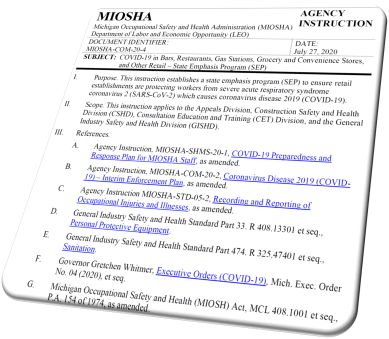
Over the course of the last month, several of our retail clients have been visited by Michigan OSHA (MIOSHA) for COVID-19 enforcement inspections in circumstances without an employee complaint or any self-reported work-related COVID-19 hospitalization or death.  The reason for these inspections, it turns out, is MIOSHA has launched a State Emphasis Program (SEP) on COVID-19 in Bars, Restaurants, Gas Stations, Grocery and Convenience Stores, and Other Retail.  We got our hands on the Directive for the Emphasis Program. Here’s a summary of what Michigan employers in those industries need to know about MIOSHA’s new enforcement strategy.

The Directive lays out MIOSHA’s approach for selecting various retail and hospitality workplaces for programmed inspections about COVID-19 infection control.

The stated purposes of the Emphasis Program is to “increase MIOSHA’s presence in retail establishments to ensure workers are protected from SARS-CoV-2,” because “employees who come in contact with large numbers of people as a result of their employment [like in retail] are at elevated risk of infection.”

The inspections are evaluating the employer’s adherence to Governor Whitmer’s Executive Orders for COVID-19, OSHA Guidance on Preparing Workplaces for COVID-19, and applicable CDC guidance for COVID-19.

The agency has created a targeting list of retail/hospitality businesses broken down as follows:

Continue reading